
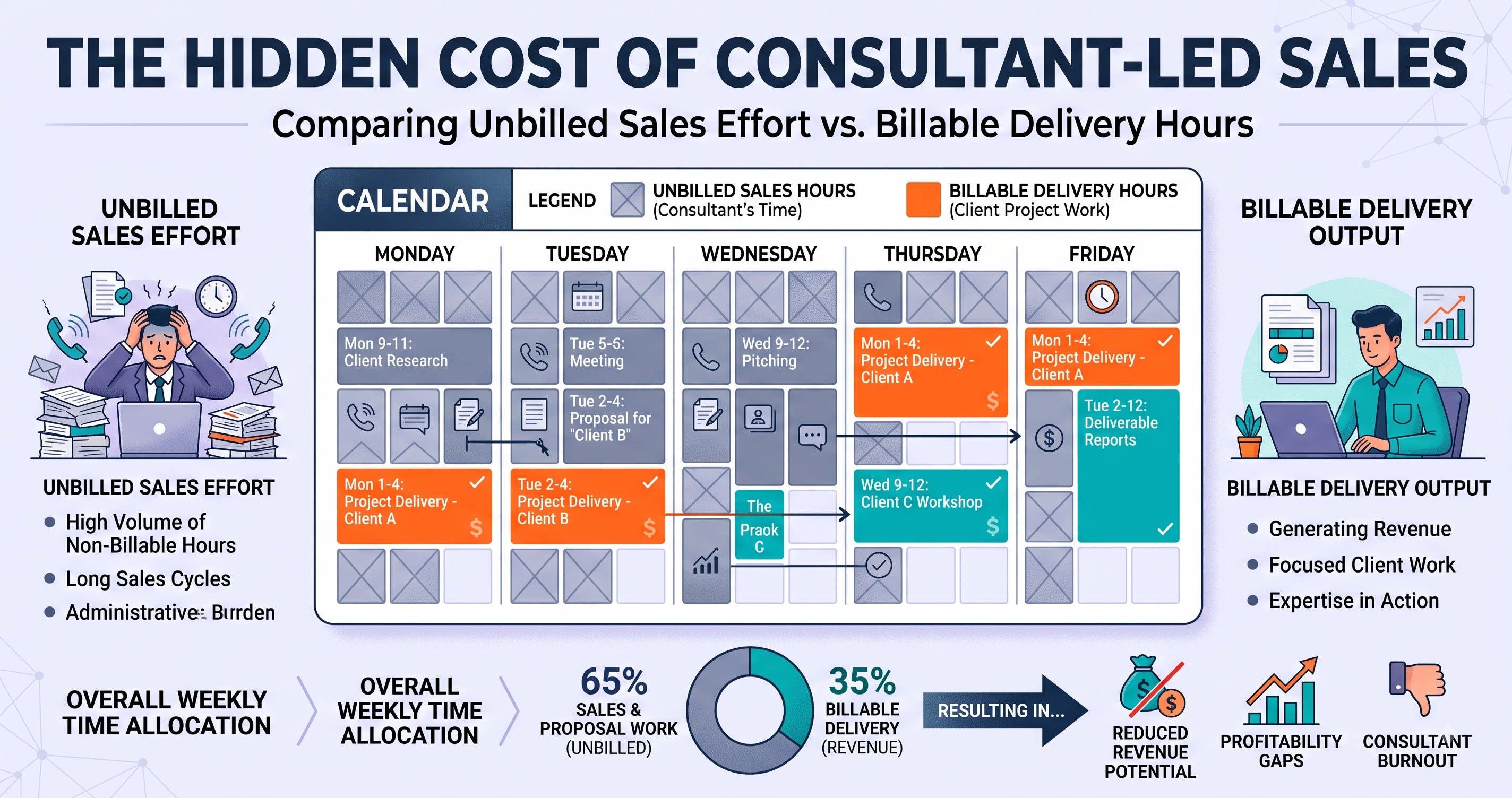
Every consultancy prices its delivery work down to the hour. Almost none of them price their sales work the same way - and that's the gap where real margin quietly disappears.
The Math Nobody Runs
Say your firm bills senior time at $400 an hour. A typical enterprise engagement takes 90 days to close: three discovery calls, a proposal built and revised twice, a negotiation call, and the informal check-ins that keep the relationship warm while procurement grinds through its process. Add it up honestly and you're looking at 30 to 50 unbilled hours from your most expensive person before the contract is signed.
At $400 an hour, that's $12,000 to $20,000 in unbilled time spent acquiring a single client - before you've delivered a single hour of the actual engagement. If that new client is worth $150,000 in year-one revenue, the acquisition cost alone just ate eight to thirteen percent of the deal, and it ate it out of the calendar of the one person in the firm whose time is hardest to replace.
That number never shows up on a P&L as "sales cost." It shows up as lower utilization, a founder's calendar with no open delivery time, and a nagging sense that growth requires more hours than the firm actually has.
Why This Cost Compounds
The real problem isn't that relationship-led selling exists - it's that it scales linearly with revenue instead of leveraging it. Every new logo requires roughly the same unbilled hours as the last one, no matter how many clients came before it. There's no learning curve that drives the cost down, because the cost is fundamentally a function of one person's calendar, and calendars don't get more efficient with practice the way software does.
Compare that to a renewal. A client who already trusts your work, already knows your team, and already has a budget line for you requires a fraction of the unbilled hours to close again - often a single call and a revised statement of work. The acquisition cost on a renewal can be one-tenth of the acquisition cost on a new logo, sometimes less.
New Logo
- 30-50 unbilled hours
- 90+ day sales cycle
- Full discovery required
- Trust built from zero
Renewal
- 3-6 unbilled hours
- Days to close, not months
- Discovery already done
- Trust already established
This is the core argument behind shifting revenue mix toward retention: it's not just a client-happiness metric, it's a direct lever on the true cost of growth.
The Part Firms Consistently Underweight
Most founders can tell you their utilization rate. Far fewer can tell you what percentage of their own hours - or their senior team's hours - went to unbilled selling activity last quarter. That number is usually higher than anyone estimates, because selling doesn't feel like a cost while you're doing it. It feels like relationship-building, which it is. But relationship-building at $400 an hour is still $400 an hour, whether or not anyone invoices for it.
The firms that manage this well don't eliminate consultant-led selling - for complex, high-trust engagements, it's often genuinely necessary. What they do is get deliberate about where senior time goes: they protect it for the deals that need it, and they build lower-cost paths - digital tools, self-service touchpoints, warmer inbound - for everything that doesn't.
A Worked Example
Picture a 12-person leadership consultancy billing senior time at $350 an hour, closing roughly 15 new-logo deals a year at an average of $120,000 each. At 35 unbilled hours per deal, that's 525 hours a year - nearly a quarter of a full-time senior person's annual capacity - spent entirely on acquisition, worth $183,750 at billing rate. None of it appears as a cost anywhere in the firm's financials. It just quietly caps how much delivery work that same senior time could otherwise produce.
Now run the same firm with a revenue mix shifted so that eight of those 15 deals come from renewals instead of new logos, at 5 unbilled hours each instead of 35. The unbilled-hour total drops from 525 to roughly 285 hours - freeing up 240 hours, or six full work-weeks, of the firm's most expensive time. That capacity doesn't have to sit idle. It can go into deeper delivery on existing accounts, into building the kind of self-service or digital asset that lowers acquisition cost on the next round of new logos, or simply back into the founder's calendar as breathing room the firm didn't have before.
Nothing about the underlying business changed in this example - the firm didn't hire, didn't cut prices, and didn't change what it delivers. It changed where senior hours were spent, and the freed capacity is worth real money whether or not it's ever invoiced directly.
What to Do With This Number
Once you know your real acquisition cost, three moves become obvious:
First, track it by deal type. New logo, referral, and renewal each have a distinct unbilled-hour cost, and averaging them together hides where the real expense sits.
Second, protect senior calendar time the way you protect billable time. If 30-50 hours of a partner's time goes into every new deal, that's capacity you're not selling anywhere else - treat it with the same scrutiny you'd apply to any other allocation of your most expensive resource.
Third, look for ways to front-load qualification before senior time enters the picture. A tool, a diagnostic, or a self-service qualifier that filters and warms a prospect before the first call can cut unbilled hours meaningfully without changing anything about how the actual sale gets closed.
Frequently Asked Questions
Isn't relationship-led sales just the cost of doing business in consulting?
To a point. The problem is not that relationships matter - it's that most firms never measure what those relationship-building hours actually cost, so the expense stays invisible even as it grows every time the pipeline leans harder on new logos instead of renewals.
How do I calculate my own cost of consultant-led sales?
Multiply the unbilled hours your senior people spend per closed deal by their normal billing rate, then compare that to what the deal is actually worth in year-one revenue.
Does this only apply to founder-led sales?
No. Any senior, billable person who sells is contributing to this cost, and it gets worse as more high-rate people spend meaningful hours on business development instead of delivery.
What's the fastest way to reduce this cost without hiring a sales team?
Increase the share of revenue coming from renewals and referrals, and build self-service or digital touchpoints that qualify prospects before a senior person's time is required.
Once you can see the real number, the case for shifting toward recurring, renewal-driven revenue stops being a retention argument and starts being a margin argument.